Contextual ePortfolio Content
The Multimodal Mini-Ethnography, in my opinion, is having the creative reign to piece together various elements of the decided text, whether it be a podcast, a TED-like talk, or an infographic, in order to reach an audience of people that we may very well have interacted with prior to this assignment. The main goal is to go one step further than what the audience knows and provide them with information on how to view or enter into the field that is being focused on in the text. It will most likely look like or in theory, follow the outline of a guide for the audience.
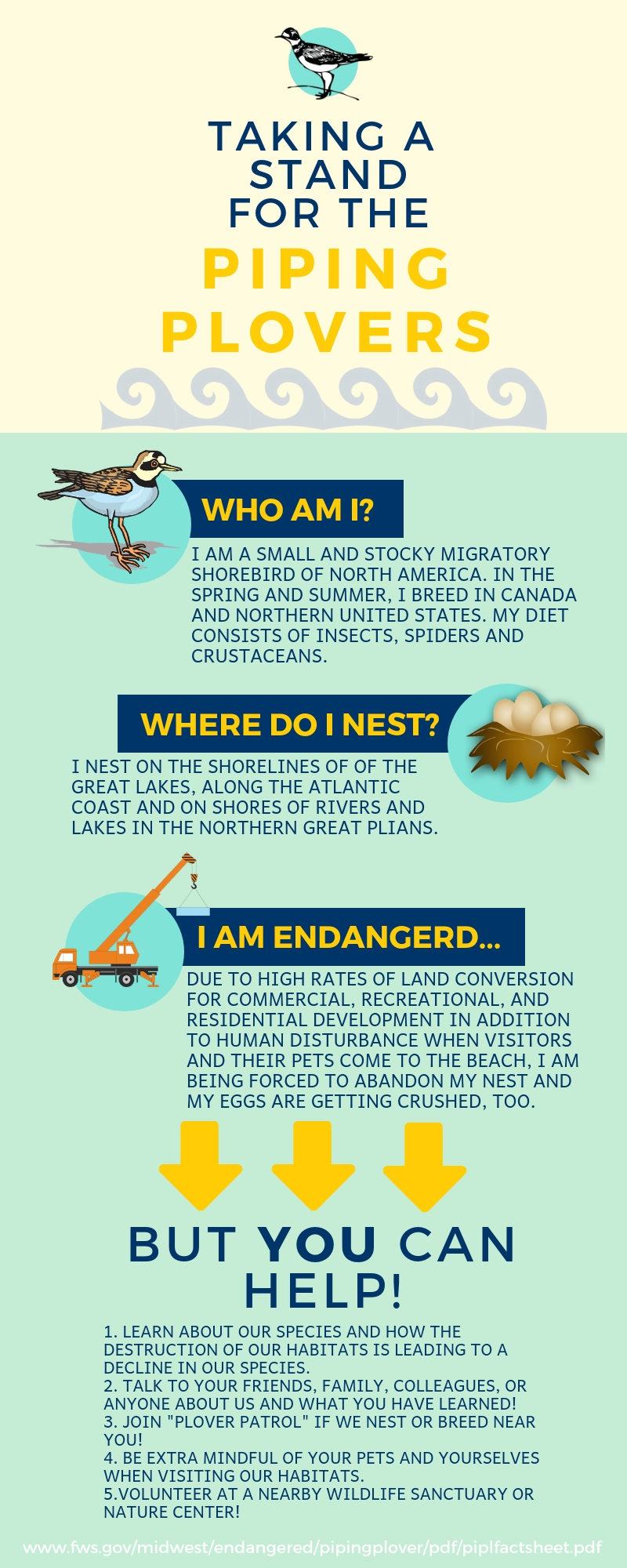
This text demonstrates my ability to write, but it also demonstrates my ability to turn information into an appealing visual that could be posted online or be turned into a post that the professional in the field post near a nesting or breeding site of the Piping Plover. But, to focus on how this text demonstrates my writing ability, I believe that throughout the process, I have become better at condensing information to a point where the important details are still there, but I am not too wordy with what I am saying. In the past, I have been notorious for saying more than I needed to and not getting to the point soon enough. In this text, however, I feel as though my point is fairly straightforward and comprehensive to my audience.
I made slight modifications to the first part of the reflection component and very drastic modifications to the medium itself. Prior, I was working on a zine, which is a mini-magazine, if you will, that is comprised of a compilation of photos, collages, and words (often poetry or short essays). This was way more time consuming than I imagined and because I have had a bit more experience using online tools to compile photos and words together, I decided to go with the infographic. For the first part of the reflection, I had originally stated that my medium was a zine, so I went through to ensure that it was clear that I was not doing a zine, but doing an infographic instead.
Here is the link to draft 1 of reflection 1: https://docs.google.com/document/d/1aErQ6irxN9NkD9pSpkgvf0dg4h-CRuE4aeWomzcFL4Y/edit
Here is the link to draft 2 of reflection 1: https://docs.google.com/document/d/1se-iQbd28P22GdxhKUrjdbmkkVW97PGCU_hSlVPYH5g/edit
Here is the link to reflection 2: https://docs.google.com/document/d/1L27ytPIO36V1vPmjJW0YQOZK8wH8uGbpap8-icHR9-Y/edit
Final Reflection 1
Reflection is a critical contributor to the success of any work of art, including a multimodal rhetorical piece. As one maneuvers their way through the various processes of the piece, reflection must occur at each stop as it allows the creator to decide what their goals are and how they can achieve them. For my particular multimodal piece, my goal is to educate my audience, most likely in the real world to be Great Lakes scientists, recreationalists, and residents, regarding the current and ongoing threat of the Piping Plover shorebird species. I am investigating how changes in land use by means of commercial and urban development along the northwestern shores of Lake Michigan are affecting the Great Lakes Piping Plover bird species. The focus of my multimodal piece will be to educate the public in an eye-capturing way through the use of a media infographic about who the Piping Plover is and why action needs to be taken NOW to stop their nesting sites and species from declining rapidly.
As with any work of art, the creation process not only includes reflection, but also setbacks and successes along the way. Throughout the process of drafting a multimodal piece on the topic I have chosen to investigate, I have had to change my topic quite a few times in order to fit the multimodal medium that I have selected to create, that being a media infographic. It is my belief that infographics hold quite a bit of potential to speak powerfully to an audience through a compilation of specific words and images that convey the topic of interest for the person who is walking along the beach or a sidewalk on their way to the beach where Piping Plovers may be breeding or nesting. I have come to the realization that I must be strategic about what colors, fonts, images, you name it, is included in the infographic in order to achieve the goal of rhetoric. Going back to the switching around of topics, it was known from the start that I wanted to investigate something to do with species, as the general topic of species has various branches, including habitat destruction as it relates to species. However, the idea of investigating a particular bird species that nests along the shores of my first love and home, Lake Michigan, did not occur to me until after doing quite a bit of research and reflection around species vitality. My original thought was that I would investigate geographic location of species and how there is a higher species density at earth’s lower latitudes than at its higher latitudes. It did not take much time for me to realize how challenging and time consuming this kind of research would be. Thus, I began to think that investigating about wetlands might be interesting, especially because I am learning about wetlands in two of my classes at the moment. The Great Lakes currently have, and always will have, a very special place in my heart as Michigan is where I spent my entire life living and growing until I came to college. Thus, I thought I might investigate how Great Lakes coastal wetlands species are affected by changes in land use. Well, upon doing this research, I came back to the Piping Plover bird. This past summer, I had the opportunity to go canoeing down Platte River with my father, which feeds into Lake Michigan. When we got to the end of the river where it meets the lake, I noticed signs posted every so many yards about keeping watch for Piping Plovers and about how we can do our part to ensure these birds are protected and free from human harm. When the Piping Plover came up in my research, I decided that this was going to be my focus.
Overall, there have been setbacks and successes throughout the overall process of drafting the multimodal piece, but I look forward to completing the project and seeing the final outcome. For now, I need to do more research and put together the words and images I have into a media infographic. Wishfully thinking, if I were to be working for a department of parks and recreation somewhere that the piping plover might reside for breeding or nesting reasons, I would love to have the infographic turned into a sign to stick in the sand or along some sort of path for people to see and become more educated and aware about.
Final Reflection 2
In this rhetorical rationale, I will explain, as outlined in the rubric, how my chosen text, which is a media infographic, has proven to be “rhetorically appropriate” for the discourse audience and purpose that I have selected for the assignment.
To start, the text has a rhetorical objective that covers the field of species diversity and wildlife health, specifically pertaining to the Piping Plover shorebird species. I chose this field because it was the field I was most interested at the time when this assignment was given to us as a class. Throughout the course of the semester, I have been studying various sustainability topics as related to science in many of my courses. Habitat destruction as well as biodiversity are two topics that relate to my chosen text. The rhetorical objective itself is to further convey my audience, who is already somewhat educated on the topic of Piping Plover conservation and protection, that the Piping Plover shorebird is particularly endangered and threatened, leading to an action call of immediate attention and effort to help save these birds.
Furthermore, in order to engage my audience and bring awareness to the field, I chose for my text to take on the persona and voice of a Piping Plover. Rather than hearing from another person who is speaking on behalf of the bird, I decided to give the bird its own voice. The bird is the one who is sharing information with the public and encouraging the audience to not be a bystander in the case of conserving the Piping Plover populations across North America. The way it turned out, in my opinion, is that this rhetorical tactic created an emotional response for the audience. It may stimulate the audience to feel more deeply connected to the bird and the awareness that it is bringing by “talking” about who they are and why they are important.
In addition to providing a rhetorical objective and bringing awareness to the audience, I have also included a genre, more or less an identity, to the text. To demonstrate the identity of , my text and to “deliver the genre” to my audience, I chose the medium of an infographic. The identity of the text, in reality, is the Piping Plover bird. This is because the written parts of the infographic are written in the voice of the Piping Plover. As far as the infographic goes, it includes short bits of information vertically represented along a portrait layout. The information also includes a graphic image by it to add to the aesthetic and give the audience a mental break from the writing. It is my hopes that the entire piece provokes a vision of Piping Plover prosperity in the minds of the audience members.
Moreover, without an arrangement of elements, there would be no medium. Thus, I have organized the infographic into a colorful, simple, yet still detailed display of both images and words along with shapes and symbols that all pertain to the overall goal of achieving effective rhetoric. Certain colors and sizes of fonts and shapes were used to draw the audience’s attention to a particular place on the infographic. This tactic was also used to ensure that the audience does not lose attention or focus on the matter at hand. My theory is that if it is pleasing to the eye, the audience is more likely to pay attention or want to know what else is there for them to learn. Another important set of questions to ask yourself when creating a visual rhetorical piece is: Is this information too wordy and are the elements too crowded or overwhelming to the audience? One of my main goals while working on the arrangement of the text was to ensure that everything appeared to the audience in a way that was not overwhelming in order to invite them in and make them feel as though they can relax and take their time as they work through the piece.
Alas, we have reached the reflection part of the process. Quite honestly, I was very excited to see this as a section for the second part of the reflection for this assignment. Why? Reflection about our decisions regarding our words, actions, behavior, attitude, you name it, leads to a more thorough understanding of who we are as humans and to a more honest look at why and how we make our decisions. All of this is applicable to the multimodal mini-ethnography assignment because upon reflection, we can understand how to go about using rhetoric in the future in various different ways. What I learned from doing this assignment is that there will never be a point in my life in which I will not have the desire to seek opportunity to learn and become more aware of the world around me. I also realized that even for those who are experts on the Piping Plover, there is still so much to learn about the bird and even more so about our actions as human consumers and how these actions directly and indirectly impact the Piping Plover shorebirds along with other living creatures. If given more time to complete this assignment, I would definitely go out and photograph Piping Plovers to show my audience what these birds are really like and just how precious their habitats are. With the photographs and the overall experience, I would create a photojournal and maybe even create a website or some online platform for people to go and look at the photojournal and make comments about it. When thinking about the ways in which this assignment is both similar to and unlike a traditional academic essay, what primarily comes to mind is freedom and room for creativity. While we still had to do research, like most people do when writing an academic essay, we were allocated more freedom to express this research and interest of ours on a much more creative and expressive level.
Finally, it is only appropriate to discuss where the information and images used for the infographic are sourced from and of course, cite the sources themselves. Thus, most of my information on the Piping Plover came from The Defenders of Wildlife Organization and the U.S. Fish and Wildlife Service. As for the images, these came from Google Images. If you go to ‘Tools’ bar under the search bar and click ‘Usage rights’, there is an option to search for only images that are ‘Labeled for reuse’. When I took journalism in high school, my advisor instructed the class to only use images that are ‘Labeled for reuse’, otherwise we are using someone else’s photo without their permission.
Sources
Final Polished Multimodal Mini-Ethnography
 Cameron Schaefer's ePortfolio