Contextual ePortfolio Content
The Major Issues assignment was designed to be a fairly smooth assignment to close out the semester. Rather than focus on a topic specifically related to our field or major, we had the opportunity to branch further out and decide on an current issue of interest to us. The main goal, the way I see it, is to create an original argument that takes a stand on whichever side of the issue and clearly points out what your opinion is about the issue.
This assignment demonstrates that I am able to write an opinion-based piece that is backed up by evidence or facts. One thing in particular that I struggled with in this assignment was using facts or evidence as the points to my argument. I was able to turn this struggle around and realize that not every research essay has to be all fact and evidence. I also learned that opinion can be even more valuable when it is followed by solid facts or evidence to support it.
I made quite a few modifications due to what was mentioned in the previous paragraph. What I did was re-read the piece a few times to figure out where most of the facts and evidence were located in the text. I kept most of it there, but instead of having only the facts and evidence, I created points to prove my argument that were opinion-based and then I inserted the facts and evidence following these opinions.
Here is the link to the first draft: https://docs.google.com/document/d/1e1OP07lULPLp5Tu1LgXHKGHAQQCqTqUVNhPdBCMb9xU/edit
Here is the link to the second draft: https://docs.google.com/document/d/1Xqqp_fssXuUmwUVKLNXKGRoPL4qO_plgxZp9y6vgH6g/edit
Here is the link to the third draft: https://docs.google.com/document/d/1j3FcGVJgY8nEZKpZTbQ0r_nXbGiIfqdx1kQYfwfgXsQ/edit
Final Polished Concept Map and Essay
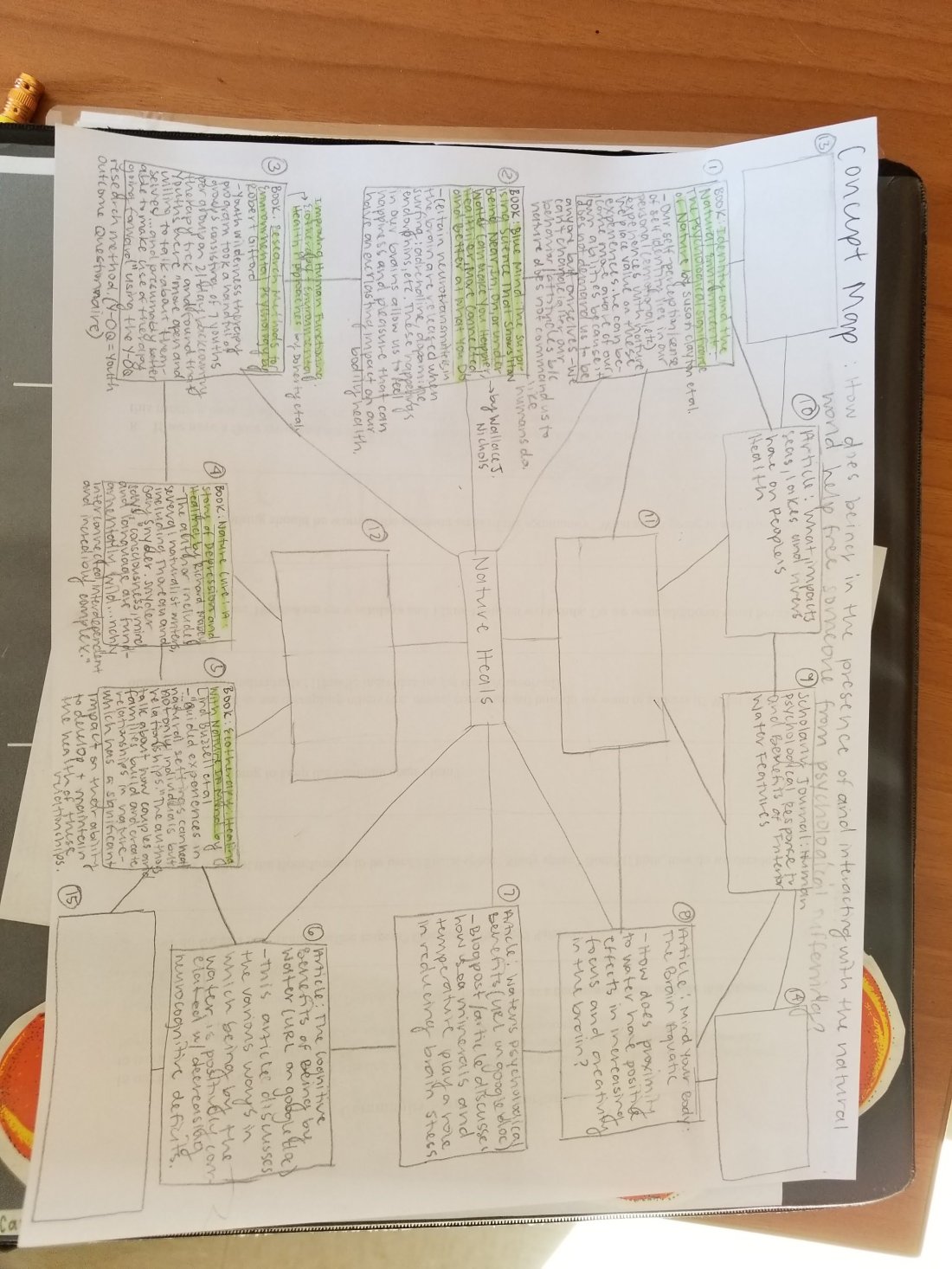
Lack of Time Spent in the Outdoors on Child Health
“‘I sort of feel free, like I can do anything in the world that I want to. It’s a good feeling,’“ explains a fifth grade student at Jerabek Elementary School in San Diego, California to Richard Louv in response to Louv’s question “How do young people feel when they do have extra, unscheduled time?” (in natural outdoor settings). This young boy is one of several children that Richard Louv interviewed during his travels across the country conducting research on child development in relation to unstructured time spent in natural outdoor settings. Richard Louv, American nonfiction author and journalist, is among many eco-psychologists, child-development specialists, city planners, and other various peoples across the nation who are continuing their quest to further understand just how critical it is for children to be spending enough time playing and exploring in, while having enough exposure to the natural world. Given that “the pace of American life, especially for children, has quickened” (Louv, 2006), it is becoming exceedingly challenging for children to not only cope with everyday stressors, but to find the time and the motivation to play and explore freely in the natural world. The discourse community that I am aiming to appeal to is parents of children. Not all, but many parents of today’s children can see and believe in the loss of unstructured time spent in the outdoors. Thus, my argument is one that they might agree with if they better understand the correlation between child developmental health and unstructured time spent in the outdoors. Clearly, the overarching problem is that urban children of today are spending less unstructured time in the outdoors, which is problematic in that the developmental health of these children is negatively impacted by this lack of exposure to natural and wild settings.
Researchers and scientists worldwide have studied the linkage between exasperation of ADHD symptoms in children and significant lack of exposure to natural settings. The argument that is being made is spending unstructured time doing whatever the child enjoys doing in the outdoors will help them develop skills such as being able to commit one’s full attention on a given task. If the child can learn to observe nature and understand the importance and role of all living things, these learnings will then go on to help them be more observant and understanding students, employees, parents, you name it. In Champaign, Illinois at the University of Illinois, researchers from the Human-Environment Research Laboratory found that spending more time in “green outdoor spaces relieves the symptoms of attention deficit disorders” (Buzzell and Chalquist, 2009), thus, a conclusion was drawn that if there is a significant lack of exposure to nature, especially the greener settings, symptoms that are associated with ADHD may be exasperated (Buzzell and Chalquist, 2009). Richard Louv points out that “we want to do what’s best for our children”, but with that being said, it is important for parents and everyone for that matter to consider that connecting with nature by spending more time with it in unstructured ways may be what is best for the child’s health and development in the long run.
In addition to the exasperation of ADHD symptoms, it is also argued that not spending unstructured time in the outdoors can contribute or lead to child depression. A factor that is prohibiting children from a desire or motivation to go outdoors and is also contributing to the higher rates of child depression is society’s increased use of technology. While there are positive benefits for a child’s psychological well-being in technology use, such as allowing children the opportunity to be self-expressive while communicating with others in ways that are encouraging growth in technological ability that is necessary for employment in the 21st century (Coleman et al, 2015), the present-day negative benefits are far outweighing. For example, three researchers, Ybarra, Alexander, and Mitchell, surveyed American youth in early 2005 via the Youth Internet Safety Survey and their results concluded that the use of chat rooms and email was positively associated with depressive symptomology (Ybarra et al, 2005). As home computer ownership continues to rise (Coleman et al, 2015), the number of children with access to the internet and the amount of time spent on the internet also rises. If children are spending more time on video games consoles, computers, cell phones, really any and all technological devices made available to young people today, they are spending less time exploring the outdoors. Ever since humans have been alive, we have seen and experienced the myriad healing benefits of nature. Many friendships and relationships are strengthened in natural settings where humans have the opportunity to enjoy the company of themselves and others which will eventually lead to feelings of joy and content that combat depression.
Along with the exasperation of of ADHD symptoms and increased rates of child depression, not spending any or enough unstructured time in the outdoors is linked to greater chances of child stress. When there is not enough green in a child’s living space, whether that be in their home, neighborhood, classroom, etc., the child will be more distracted by the non-living things in the room or space and is more likely to not develop the ability to appropriately handle the stressful situations in their lives. Going on walks in the forest or on the seashore has allowed millions of people across the world to clear their mind and reflect on their feelings and emotions. As children spend less time in places such as the forest or the seaside, this opportunity to learn to appreciate the value of time for self reflection is lost. When self reflection does not happen, a child’s ability to even be able to recognize what stress is and what is causing the stress is eradicated. Much of our habits in handling stress are learned at an early age and are often learned on our own or with others in natural settings. Many stressful events can be caused by nature, but if children better understand nature and have spent more time with it, they will be able to appropriately handle this stress. Moreover, Kals and Ittner argue that through experiencing nature, especially beginning at an early age, one behaves in a nature-protective way which will therefore lead to the development of an environmental identity (Kals et al, 2003). The development of identity, in this case the environmental identity, is constantly taking place from birth to death, however, it is deeply rooted at an early age, which is an important factor in determining a child’s understanding of the importance of conserving nature. To include, Nancy Wells, assistant professor of design and environmental analysis in the college of Human Ecology at Cornell, among her colleagues, environmental psychologists, found that in 2003, children who live in conditions highly exposed to nature, even if there is nature in the room or in a room with a view of a natural setting, their levels of stress in response to life events were significantly lower in comparison to children living in low-nature conditions (Louv, 2006).
In summary, it is evident that the overarching problem is that urban children of today are spending less unstructured time in the outdoors, which is problematic in that the developmental health of these children is negatively impacted by this lack of exposure to natural and wild settings. The evidence pointing to the psychological benefits of spending unstructured time in natural outdoor settings is in everything we see and everything we do because we humans have innate biological connections to the Earth. Societies must work together to develop ways in which children have the opportunity, time, and motivation to maximize exposure to and play in natural outdoor settings in order for the coming generations to be healthy and to understand the role that they have on nature and vice versa. As Rachel Carson, American Marine Biologist, novelist, and conservationist, once uttered, “Those who dwell among the beauties and mysteries of the earth are never alone or weary of life.”
 Cameron Schaefer's ePortfolio